Back to romance?
Re-igniting the rage against the machine
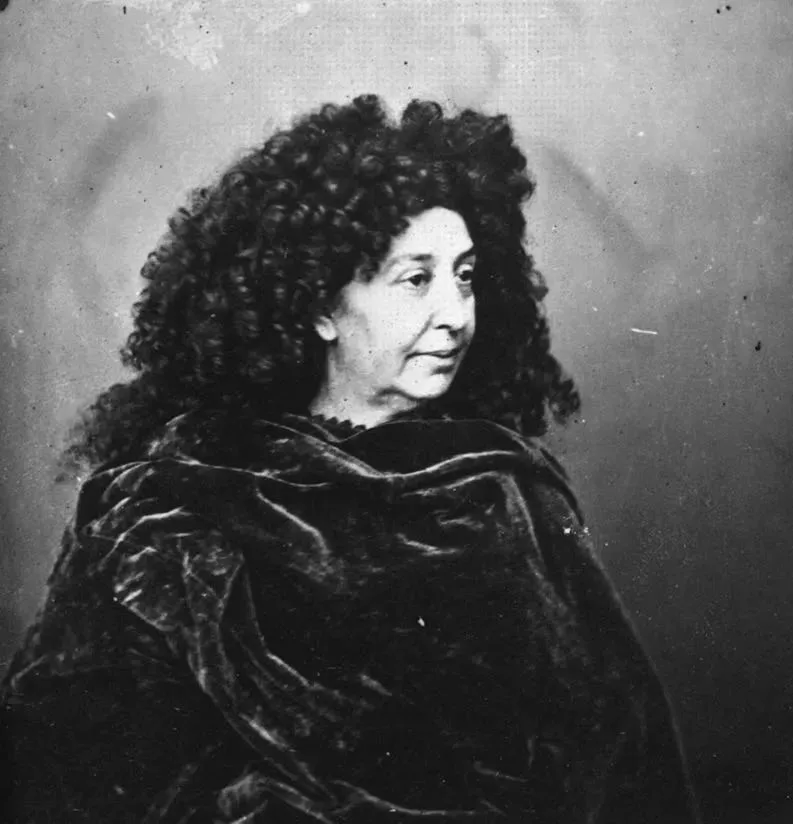
*“It is never wise to neglect the heart’s reasons, which reason knows nothing of.” * Eric Hobsbawm - The Age of Revolutions
When I was a young boy 6 or 7, growing up in the port city of Durban South Africa, I distinctly remember waking up one morning with a deep sense of dread. I ran to my parents’ bedroom deeply distressed. My mom, alarmed, asked me what was wrong? “I have, I have… …no adventure in my life!” I cried.
Little did I know I should not have worried. We lived in a world under the threat of nuclear annihilation. My own country was under the already teneous grip of the apartheid state. We lived underneath the radar, we lived underneath the bomb.
Today we also live in tumultuous times. Soon I am celebrating my birthday with friends. Since I organised it, who would have guessed a war of aggression would break out? Who would have guessed a world leader would threaten to use nuclear weapons? So, when looking for a theme for my party, I cast my mind back to an analogous messy and significant period in history.
It was easy to settle on one.
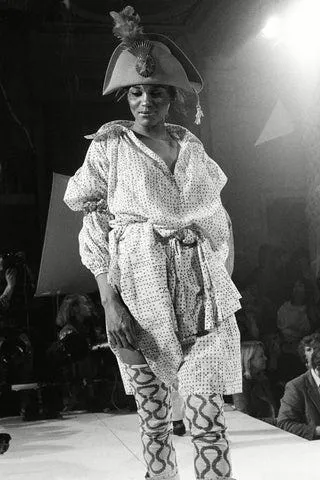 Caption: A recent reinterpretation of new-Romantic fashion.
What the late 18th and early 19th-century Romantic movement were for is hard to put your finger on, but not what it was against. It was a reaction to the world-changing impact of the ideas and way of life that spread because of the French Revolution, and its cousin, the Industrial Revolution. It was clear what the Romantics detested - the middle. Says Eric Hobsbawm in The Age of Revolutions:
“The contrast between a world theoretically wide open to talent and in practise, with cosmic injustice, monopolised by soulless bureaucrats and pot-bellied philistines, cried to the heavens. The shades of the prison-house –– marriage, respectable career, absorption into philistinism - surrounded them.”
George Sand spoke for the rebellious reaction of many a Romantic when she proclaimed:
“Once my heart was captured, reason was shown the door, deliberately and with a sort of frantic joy.”
Byron was clear-headed enough to foresee that only an early death was likely to save him from the respectable old-age this new world made not only possible, but likely. He did that by joining the Greeks in their independence struggle against Turkey — and paid with his life.
But the fundamental problem the Romantics had with the new bourgeois world created by the twin revolutions was not its lack of adventure, but that it was profoundly asocial. And the Romantics set themselves against the alienation that resulted from that. This was a new world that:
“…left no other nexus between people than naked self-interest. It has drowned the heavenly ecstasies of religious fervour, of chivalrous enthusiasm, of sentimentalism, in the icy water of egotistical calculation. *It has resolved personal worth into exchange value, and in place of numberless indefeasible freedoms, set up a single unconscionable one, free trade.” *
The voice speaking here was that of the Communist Manifesto - but says Hobsbawm, it speaks for the Romantics raging against alienation also.
The end of history was a long time coming
Underworld’s first hit, We Live Underneath the Radar, was released in 1988. Only a year later, it was dated. Because in 1989, when I was 17, the Berlin Wall fell. Although I sensed that the world had changed dramatically and that somehow, I would be affected by it, I had no idea how.
But somebody had some ideas. Months before the surprise fall of the Berlin Wall, a precocious young man called Frances Fukuyama wrote an essay which predicted the fall of the Soviet Union and much besides. In The End of History Fukuyama wrote:
“The triumph of the West, of the Western idea, is evident first of all in the total exhaustion of viable systematic alternatives to Western liberalism… this phenomenon extends beyond high politics and it can be seen also in the ineluctable spread of consumerist Western culture in such diverse contexts as the peasants’ markets and color television sets now omnipresent throughout China, the cooperative restaurants and clothing stores opened in the past year in Moscow…”
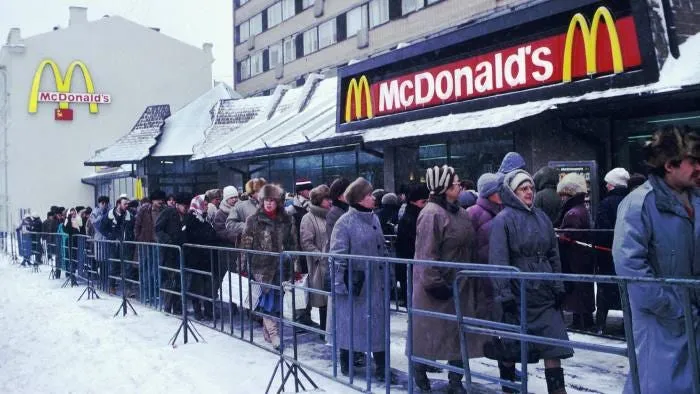 Caption: The iconic launch of Macdonald’s in Moscow in January 1990.
Fukuyama argued that a powerful (and outrageous) assertion made by Hegel way back in 1806 was making itself evident in 1989. Hegel is known (among other things) for his view of history, that despite struggles and setbacks, the future is always brighter than the past. History, shorthand for human freedom, is always on the march forward.
In that view, Hegel was not unique. But Hegel was the first to proclaim history to be at an end. He did so in 1806 after witnessing Napoleon’s spectacular victory over the mighty Prussian army at the battle of Jena (today a 2-hour drive from Berlin).
To be sure it was a physical victory of blood and steel, but more importantly for Hegel was what the victory said about the world of ideas. He put Jena down as a victory of the ideas and ideology of the French Revolution.
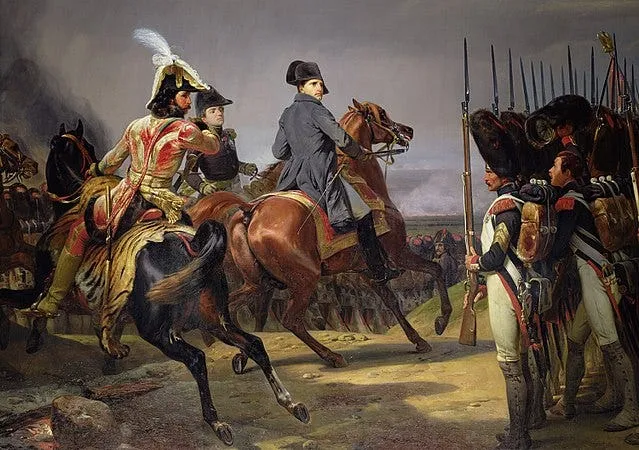 Caption: Napoleon at Jena
Continuing his essay, Fukuyama argues that the greatest modern student and interpreter of Hegel was a Russian émigré to France named Kojève. Despite the horrors of WWI and II, Kojève kept to Hegel’s idea of The End of History. For Kojève said that*:*
“…while particular regimes in the real world might not implement these ideals (of the French revolution) fully, their theoretical truth is absolute and could not be improved upon…”
And if ideological development had in fact ended, “the universal homogenous state” would eventually become victorious throughout the whole of the physical world.
At The End of History, this universalising state will be liberal in the sense that it will recognize and protect humankind’s inherent freedom through the law, and democratic in the sense that it will exist only with the consent of the governed. (And since it would be everywhere there would be no need for borders. That’s great right?)
Many of the friends I invited to my birthday party I met as this universal homogenous state spread. In cool Britannia, in Berlin. Would we have known each other if it had not?
Yet, an often-unremarked part of the essay is that Fukuyama saw an ambiguity in the state of affairs the spreading universal homogenous state would usher in.
“For Kojève, this so-called “universal homogenous state” found real-life embodiment in the countries of postwar Western Europe - precisely those flabby, prosperous, self-satisfied, inward-looking, weak-willed states whose grandest project was nothing more heroic than the creation of the Common Market”

Moreover, wrote Fukuyama, wistfully (and in a very male-centred way), in this future with no history – there will be no passions, no big adventures. In this future there…
“…is no struggle or conflict over “large” issues, and consequently no need for generals or statesmen; what remains is primarily economic activity.
As a matter of fact, Kojève’s life aligned with his teachings Fukuyama tells us. Believing that philosophers like himself had no work to do since Hegel had already achieved absolute knowledge, he left teaching after the war and worked as a bureaucrat for the European Economic Community until his death in 1968.
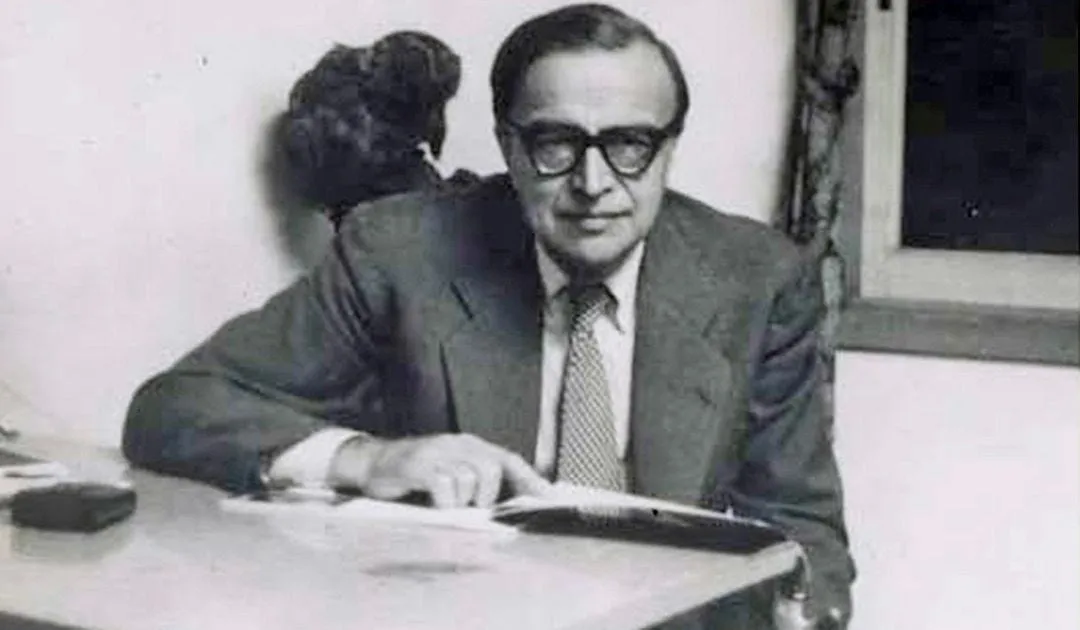 Caption: Kojève the bureaucrat.
This kind of thinking by Kojève is what Timothy Snyder, Yale historian and an expert on Ukraine, calls “the politics of inevitability”. A politics that has been dominant in the US and Europe for decades. The basic notion on which this politics is built is that Fukuyama was right. History was over. Markets bring capitalism. The West is exceptional, “but will no longer be because everyone will soon become like us.”
Thinking like that brings with it a predictable set of problems says Snyder. Like, for example, wealth inequality, because all sorts of things that you expect to be progressive don’t turn out to be. So, we thought it doesn’t matter if oligarchs emerge. Because all that matters is creating a market economy. And that market economy will then magically resolve all the political and administrative, institutional, moral and cultural problems for us. We can buy energy from who we please. We do not need to regulate banks, as the market is self-correcting. This while technology and innovation will save us from environmental disasters. And oh, the internet is going to be liberating, democratising and a force for good.
And you never have to think about what values you may want, and how they may differ from the values of others. Because that’s redundant. And neither do your institutions, your technology, your art or architecture attempt to embody the values that you think would make for a better world. “The market is like mom, it will take care of you.”
Snyder’s insight is not unique. It is why Fukuyama’s essay soon became notorious for a kind of gormless liberal nihilism. But Fukuyama is perhaps unfairly criticised for being an evangelist for The End of History. The last paragraph of his essay which is rarely noted reads:
“The end of history will be a very sad time. The struggle for recognition, the willingness to risk one’s life for a purely abstract goal, the worldwide ideological struggle that called forth daring, courage, imagination, and idealism, will be replaced by economic calculation, the endless solving of technical problems,.. and the satisfaction of sophisticated consumer demands. In the post-historical period there will be neither art nor philosophy, just the perpetual caretaking of the museum of human history.”
There is a crack in everything, it is how the light gets in?
Yet many intellectuals see in a series of events, culminating in Ukraine a turning point, that asks serious questions about The End of History. Asked about the West’s failure to plan for the food crisis brought about by the Ukraine War, my favourite public intellectual, economic historian Adam Tooze, had this remarkable answer:
“We did not expect the war to go on. We expected the war to be short. We expected Russia to be in full control. So it’s the resistance of the Ukrainians, which is the wild card here. It’s exposed the inadequacy of the calculus of the west, as much as the inadequacy of the calculus of the Russians.
You know, that folks like me, who, who deal in technocracy and its logic and power, are often confronted by critics who say what you, you discount the role of resistance. You don’t focus enough on the opposition. You don’t understand the grassroots – and it’s true. And I genuinely don’t because I don’t think it matters. And relatively speaking, I think it’s actually powerless.
But if you ever wanted a counterexample of the way in which genuinely popular, organized resistance has totally disrupted the calculations of power, this would be it.”
And Timothy Snyder also thinks the war has larger implications because:
“…imagine that Zelensky had fled and that the state had collapsed, right? What kind of suffocating, intellectually and morally narrow, hollow world would we be in right now? What would we be talking about right now? Thanks to the fact that they’re doing something, they’ve given us this chance to think bigger.”
But let’s not kid ourselves. At my party, we will dance underneath the radar. But relatively safely. Where we will be, an hour from Berlin, is not the same as being in Kherson or Kharkiv.
Habermas captures some of this when he recently wrote about a gap that exists between Ukraine and Germany. Ukraine is struggling to become a nation-state. Germany is well beyond that. Germans, as well as the rest of us in the West, should think about this gap when considering our spontaneous reactions of enthusiasm and solidarity with Ukraine:
“We thrill to the heroism of the Ukrainians, which puts into stark relief the deflated state of our own politics. But our post-heroic culture cannot simply be cast-off in disgust”
Unlike Byron, I’m not joining the Ukrainian army. I am well into soft middle age. I myself quite like being comfortable and…
Not drinking too much Regular exercise at the gym (3 days a week)
Fitter Happier - Radiohead
So it’s in this strange in-between world, where History’s End still lives, but where we are now all too aware of its mortality (and I of my own), where my friends and I will see each other again.
At this party, like when I was 17, we will half dance underneath the radar. We are again kind of living underneath the bomb. Perhaps that weekend we can briefly get back to the future. A test run in casting off our post-heroic culture and alienation in disgust, dream of utopias — and have a little adventure.
“Art for art’s sake is an empty phrase. Art for the sake of truth, art for the sake of the good and the beautiful, that is the faith I am searching for.” - George Sand
First published at leviathan.substack.com.