The wider implications of the case against Google (links 2)
And the importance of state funded research; cross-disciplinary thinking; it's us that's to blame, not the algorithms; Privacy is complicated.
In this week’s newsletter: the antitrust case against Google and what it means for the digital ecosystem; The importance of cross-disciplinary thinking — to make sense of AI; How state-funded research is superior; More evidence that it’s not the algorithms but us poisoning the information sphere - and privacy - it isn’t very easy.
 Caption: Via Midjourney
The State vs Google
The US Department of Justice antitrust complaint against Google is arcane and technical. Still, quite an eye-opener, it lists a range of blatant practices that, on the face of it, puts Google’s old motto of “Don’t do evil” well to rest.
See, for example, here and this tweet by Ari Paparo.
How to deal with Big Tech and the power they wield?
When new FTC chair Lina Khan was appointed, much was made of her new approach in terms of antitrust that would not focus on economics’ orthodox consumer welfare standard as measured by monopoly prices. The reason for her approach was simple enough: most of the “Big Tech” services are free to use for consumers.
Instead, the focus with Khan would be on something more abstract: a concentration of power. This idea is not wholly alien, and it has been the philosophy behind regulation to ensure media plurality in the past.
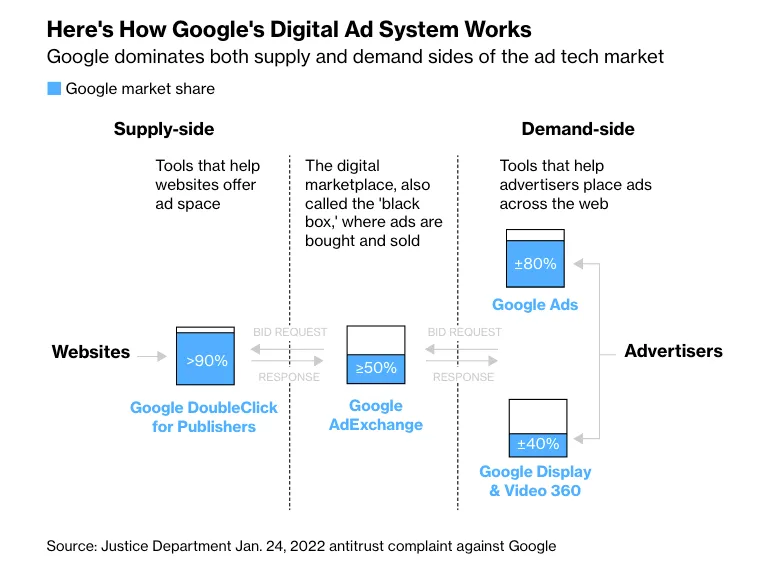 Caption: Graphic: Bloomberg
But this case against Google is old school. Specifically, the US Sherman Act’s requirements for muscling out the competition to raise prices or offering substandard service (in this case, advertisers paid more while also significantly lowering revenue for publishers) are relevant.
This makes Google vulnerable even when its market share in digital advertising is at a years-long low: Amazon has joined Google and Facebook to become the third major player (See below graph).
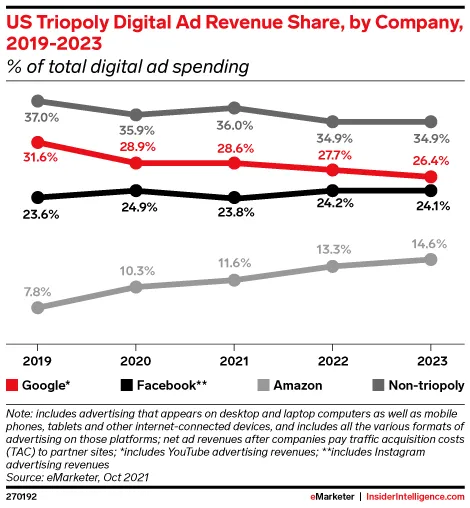 Caption: Google is a player with a declining share in a triopoly that is taking an ever bigger share of digital ad revenues.
And this is so even when we are only talking about the so-called “Open Display” part of the advertising market on 3rd party publishing sites. Open Display, even if it caters for everyone except for the owned and operated platforms of Google, Meta and Amazon, is a far smaller slice of the digital advertising market.
And Open Display earns a far smaller subset of Google’s advertising revenue than its owned and operated Google Search, and about as much as YouTube — and only 12% of overall revenue (See graph below).
![How Does Google Make Money? [Updated Dec 2022] | Oberlo](/_astro/4.CquYEBo__14fjVS.webp) Caption: “Google Network ads” is the “Open Display part” of Google touched by this case.
Caption: “Google Network ads” is the “Open Display part” of Google touched by this case.
As The Information points out, “while Google’s display ad business has grown, any publisher that is heavily dependent on it is no longer in business—or won’t be much longer. But that doesn’t mean this case isn’t important.”
That’s correct; it’s still important because several notable issues arise. In our era of disinformation, Google’s shortsighted actions appear to have contributed to the demise of journalism and the media in general. As print (and now broadcast advertising) shrinks, Open Display Ads, are not delivering for publishers going digital either.
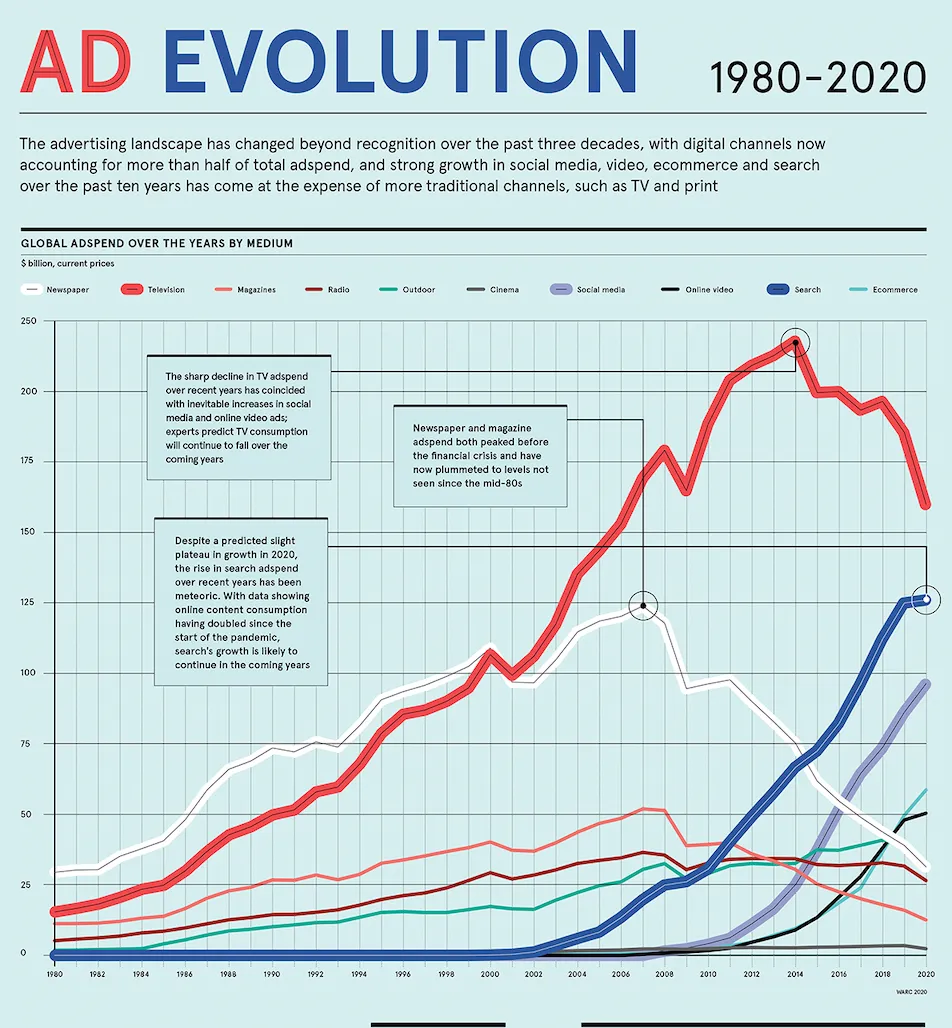
All the more remarkable because Google’s mainstay search business relies on the existence of a reliable and quality open web, which Google’s actions appear to have worked against.
Another nail in the coffin of the Open Web?
And if Google is forced to disinvest in the sell side of Open Display advertising (as the DOJ complaint wants), will it cause the company to focus more on its owned and operated services? I have highlighted before how Apple’s App Tracking Transparency (ATT) is leading to consolidation online by incentivising large owned and operated advertising platforms.
And what could this mean for Google’s plans for Chrome-based Privacy Sandbox, the project that sought to replace 3rd party cookies1, which the Open Display ecosystem uses for targeted advertising?
Continues Jessical Lessen in the Information:
One thing I’m more certain of is that this isn’t the last challenge to a tech ad business we’ll see from regulators. I’m not even sure it’s the most important. Imagine the company selling ads was also directly selling products that competed with those depicted in the ads (Amazon!). Imagine a hardware company that sold ads was letting itself use far more targeting data to sell its ads than it was allowing its rivals to use (Apple!).
PS: From the DOJ case it appears Google was doing similar to Apple now with ATT, using privacy as an excuse to cut competitors’ use of data.
The importance of state-driven research innovation
A new paper is out making a fascinating claim:
Figuring out the impact of AI
We need more people with interdisciplinary skills, like Paul Meehl, to understand our AI future tweeted Jonathan Anstray this week.
 Caption: Paul Mheel
Meehl was a statistician, a therapist and a philosopher of science. One of his notable contributions was a paper that argued way back in 1954 that statistical predictions would beat clinical predictions (decisions based on professional clinical judgment).
In this vain, here are two interesting papers:
First, an impressive new paper from Google: When Google tuned a chatbot to answer common medical questions, doctors judged its answers 92.6% correct, compared with 92.9% of the answers given by other doctors.
And…
It’s us, not the algorithms
Political Scientists Henry Farrell and Cosma Shalizi present a new preprint to illustrate an argument that I have made here and here (but not using the same example): how the problems of our information ecosystem might arise from simple web 2.0 technology without any algorithmic curation of content.
Their basic argument is summarised well by Karl Bergstrom over on Mastodon:
We can explain the prevalence of misinformation and polarization as a consequence of (1) disatisfaction with status quo explanations, (2) psychological desire to find plausible rationalizations for pre-existing beliefs, and (3) preferential attachment dynamics such as arise from even non-individualized search engines, citation processes, and other such systems.
Meta-void
I’ve long been sceptical about claims for the Metaverse. But I did not think much about the technical hurdles it faces.
A long and detailed post by VC Matthew Ball is packed with technical reasons why VR/AR/MR has not lived up to the hype. Ah, I hear you say. The Metaverse is not limited to those platforms and will be accessed via smartphones and laptops instead.
In this thought-provoking presentation, games designer Raph Koster - and ex-Disney / Playdom vice president, explains that the Metaverse is neither new nor unique and that its main problems are not technical — but social.
Digital Privacy is complicated
Techcrunch has a story on how US police gathered evidence from digital service providers to prosecute several abortion cases.
Privacy fundamentalists - ie almost everybody on Twitter - consider people’s right to keep their data safe, secure, and out of prying hands to be sacrosanct. Among children’s rights organizations, the digital world’s nastiness requires more protection. It is impossible to move either of these groups’ positions. That is, until both sides clash.
And a judge upholds DOJ’s broad “geofence” warrant allowing prosecutors to use Google location data to identify people who entered the Capitol on Jan. 6.
Privacy Sandbox for the Web aims to phase out third-party cookies by using the new privacy techniques, like differential privacy, k-anonymity, and on-device processing.
First published at leviathan.substack.com.